
"Let the food be thy medicine and thy medicine be thy food" - Hippocrates (460-370B.C.)
Anti-nutrients
Anti-nutrients, as the name implies, are compounds that interfere with the absorption of nutrients by the body.
Many foods that we consume contain anti-nutrients. However, if we know how to prepare these foods properly, we can eliminate much, if not all, of those anti nutrients.
It is therefore as important to recognize the foods anti nutrients, as it is to know its own nutrients and benefits, because the anti-nutrients themselves can be responsible for inhibiting the absorption of the nutrients reducing dramatically the benefits of the foods.
Interestingly, our ancestors knew how to prepare their foods properly, in a way that would minimize and eliminate the anti-nutrients from their foods, by germinating and fermenting them.
In a general mode, grains and seeds are the ones that have a great arsenal of anti-nutrients. Why? Well, because the last thing that a plant wants is its seeds to be digested. It is a normal procedure for animals in nature to feed themselves on fruits and pods that contain inside them grains and seeds. So plants created such a self-defense mechanism, one that saves its seeds. The plants created a way for its seeds to be defecated in a intact state so they can germinate on earth. This self-defense mechanism is the presence of anti-nutrients that inhibits the digestion of those grains and seeds. (We open an exception here for the birds whose digestive systems are properly adapted for the consumption of grains and seeds.)
We, humans, usually process and cook grains and seeds, such as legume seeds, beans and cereal seeds. However, after processing and cooking, a large portion of anti-nutrients remains. Thus, the digestion is slow, difficult, gas is produced in the intestines, and the absorption of nutrients by the body becomes at least deficient.
One way to minimize the presence of anti-nutrients is soaking the grains, beans, nuts or seeds in water.
Generally, soaking time is about 8-24 hours, except for some fast soaking seeds, such as the quinoa seeds.
In order to make the grains, beans and seeds, which are part of the common diet, lighter and digestible, we must soak them overnight and then rinsing them and let them germinating with moisture and air for a further 48-96 hours. These procedures should always be considered, before cooking grains, beans or seeds, in order to minimize some of the anti-nutrients undesirable effects.
All legume seeds, grains, nuts and seeds should be soaked and germinated. This is the ancient secret for consuming food that will promote digestive wellness, enabling and enhancing the absorption of nutrients from the food itself.
How should beans be eaten?

To go around this issue, and around the anti-nutrients, we must, in a first stage, soak the beans for 12 to 24 hours, depending on the type of the bean.
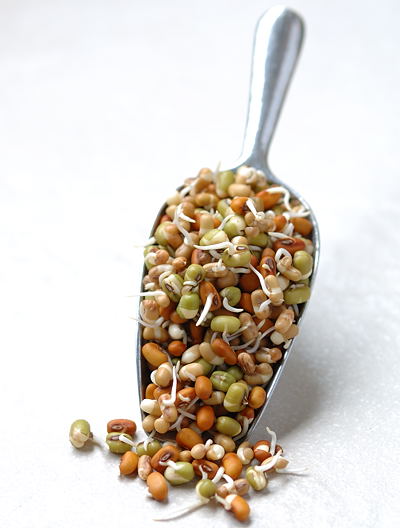
The water will wake the seeds from its dormancy, awakening them to life and starting its germination process. In a second stage, the beans should be rinsed, drained and placed in a large strainer or sieve, where they will remain in the air, and must be rinsed at least twice a day. The goal is to keep the beans always moist and fresh. In the summer months you may even put them in the refrigerator at a soft cold temperature. During the germination process, the seeds will release the anti-nutrients, initiating a series of transformations that inactive the enzyme inhibitors and pre-digest the protein. This is why it is so common to say that a germinated seed is a seed pre-digested.
After 2 to 5 days in air, depending on the type of beans, the formation of a little rod will be noticed, this reveals that the germination is completed. Once germinated, the beans may be steamed and, when digested, the nutrients can be greatly absorbed by the body.
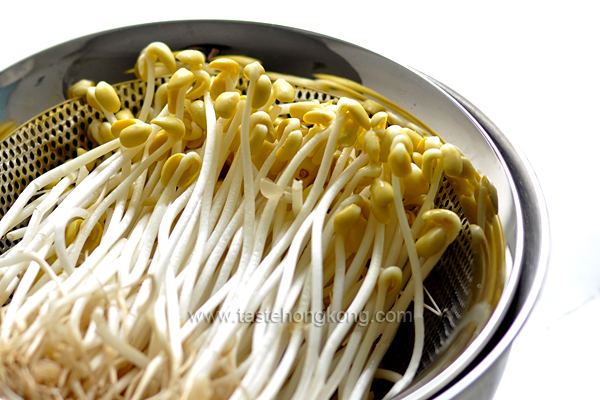
Some lighter beans, such as mung bean, may be left longer in the air, to produce sprouts with up to 3 to 4 inches tall, and some may even present leaves. Sprouts can also be grown on organic soil.
So sprouting is a more advanced stage that follows after the germination process. The sprouts can be eaten raw, marinated or lightly cooked.
(Specifically in the case of black beans, we do not recommend sprouting them, because the leaves may be toxic.)
Soybean Anti-Nutrients

The soybean has a high content of anti-nutrients, including phytic acid and enzyme inhibitors that, for instance, block the action of trypsin, a special enzyme which acts in the small intestine helping in the digestion of food proteins.
So, why is soy presented to the public as a healthy source of protein, when in reality, soy contains within itself the inhibitor for protein digestion?
Well, big corporations related to the food industry took advantage of public with little knowledge and created the illusion of a healthy product, with a very specific purpose in mind - monetary profits! The most serious problem is the fact that the exploration of this food has escalated to the level of genetic manipulation and is, today, one of the genetically modified foods (transgenic), most sold and consumed over the entire globe, whether through processed foods for human consumption (such as soy milk, soy meat, soy flakes, soy grains, etc.), cosmetics, biodiesel, whether through animal feed (which will also end up on your plate, if you are a meat eater, because that meat was probably fed with that feed)
If we allow ourselves to be well informed, we know that transgenic foods (GMOs) bring dangerous harm to human health. (Learn about the Dangers of GMO and the Lies that you are told!)
If we allow ourselves to be well informed, we know that transgenic foods (GMOs) bring dangerous harm to human health. (Learn about the Dangers of GMO and the Lies that you are told!)
How should soybeans be eaten?
Primarily, all soy products that we eat should be organic, precisely to assure us that the food is not transgenic, and to preserve our health.
Secondly, we must prepare the soybeans in a way that minimizes or even eliminates its anti-nutrients.
Somehow, our ancestors knew that, if not properly prepared, soybeans would not be very well digested. And how did they prepare it? Germinating and fermenting it. Plus it was eaten with moderation.
It is common for Westerners to eat soybeans as a substitute for animal protein. On the contrary, Asians eat soybeans in small amounts, as a condiment, as miso and tamari (soy sauce), or natto, tempeh and tofu.
Remember that soybeans are originally from China and Japan.
The following soy products are healthy and are available in many western supermarkets as well as in ethnic markets and health food stores. Remember, you should only buy products which contain certified organic soybeans. Look for the certificate in the package, because it assures you that you are not buying products derived from genetically modified soybeans.
Miso
Miso is a traditional Japanese seasoning produced by fermenting the soybeans (or rice or barley) with salt and fungus Aspergillus oryzae. The result is a thick paste used for sauces and spreads, pickling vegetables or meats. Miso is high in protein and rich in vitamins and minerals.
Tamari (soy souce)

Tamari, or soy sauce, is a condiment made from a fermented paste of boiled soybeans, roasted grain, brine, and Aspergillus oryzae or Aspergillus sojae molds.
Natto
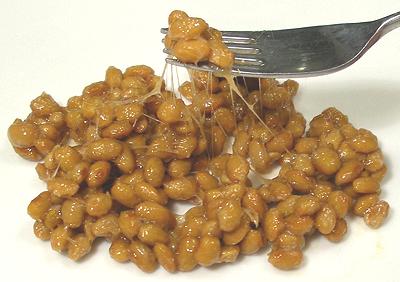 Natto is a traditional Japanese food made from soybeans fermented with Bacillus subtilis.
For some natto is unic, because of its powerful smell, strong flavour and slimmy texture, however others find it repulsive.
Unlike the non-fermented soybean, this viscous soybean is rich in enzymes that aid digestion and is very nutritious (during fermentation B2 and K vitamins are produced and also minerals such as iron, calcium, and potassium). Due to the expansion of the popularity of this food, some industries are already producing odorless natto (for those who find the original smell of natto repulsive). Natto is typically eaten on hot white rice.
Tempeh

Tempeh is made by a natural culturing and controlled fermentation process that binds soybeans into a cake form, similar to a very firm vegetarian burger patty.
It is very nutritious, preserving a high content of protein, dietary fiber and vitamins. Used worldwide as a meat analogue, in vegetarian cuisine, tempeh has an earthy flavor which becomes more pronounced as it ages. In good tempeh, the beans are knitted together by a mat of white mycelium.
The soy carbohydrates in tempeh become more digestible as a result of the fermentation process. In particular, the oligosaccharides associated with gas and indigestion are greatly reduced by the Rhizopus culture.
The fermentation process also reduces the phytic acid in soy, which in turn allows the body to absorb the minerals that soy provides.
The fermentation process also reduces the phytic acid in soy, which in turn allows the body to absorb the minerals that soy provides.
In the kitchen, tempeh is often prepared by cutting it into pieces, dipped in a savory sauce and then fried, baked or stewed. It can also be shredded and used as ground meat substitute. Tempeh's complex flavor has been described as nutty, meaty and mushroom-like.
Tofu
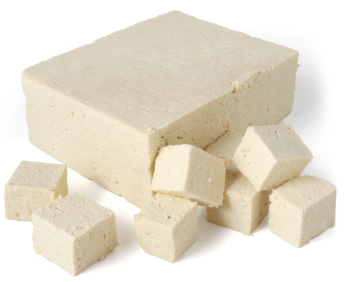
 Tofu is not as healthy as the soybean processed products described above. This is so because it brings with it some anti-nutrients and enzyme inhibitors. Actually the tofu is a precipitated product, it is not fermented. Therefore tofu contains phytates that block mineral absorption and trypsin inhibitors that block protein digestion. If you still want to eat tofu, eat it with moderation.
 Tofu is not as healthy as the soybean processed products described above. This is so because it brings with it some anti-nutrients and enzyme inhibitors. Actually the tofu is a precipitated product, it is not fermented. Therefore tofu contains phytates that block mineral absorption and trypsin inhibitors that block protein digestion. If you still want to eat tofu, eat it with moderation.
Originated in China, but also very common in Japanese cuisine, it is used in moderate amounts in the east. Its manufacturing process is very similar to the cheese making process from soy milk. So it is also known as bean curd. It has a subtle flavor and can be used in savory and sweet dishes. It can be eaten raw, fried, baked, in soups, sauces, etc. In fact, it is coagulated soy protein. The most commonly used coagulant is magnesium chloride and nigari. The best tofu is always the fresh tofu. You will find it in grocery stores in the cold section. And once again, I recall that the right choice is always fresh certified organic tofu, since we want to assure ourselves that it is not made from genetically modified soybeans.
How should chickpea be eaten?

Like other legumes, chickpeas also have a considerable amount of anti-nutrients. However, the anti-nutrients will be released after soaking in water the chickpeas for 24 hours and then allowing them to germinate in air for 3 to 4 days. Remember that during the germination process, the seeds should be kept moist, so you should wash and rinse them at least 2 times a day.
 The germination process results in the formation of the seedling, the plant embryo contained in the seed shows itself and continues to grow.
 The figure at right shows a considerable spike but from the moment it becomes visible, like a protruding 'nose', the seeds are ready to be eaten.
This process increases the nutritional potential of the seed and prevents its fermentation in the digestive tract, which means no gases.


No comments:
Post a Comment